
Cat6 Cable Ireland: The Complete Specification and Installation Guide
Cat6 cable (Category 6) is the current baseline specification for new structured cabling installations in Irish commercial and public-sector buildings. It superseded Cat5e as the recommended minimum performance standard because it supports 10 Gigabit Ethernet at short distances, offers improved alien crosstalk rejection, and delivers sufficient headroom for modern PoE+ and PoE++ power delivery requirements.
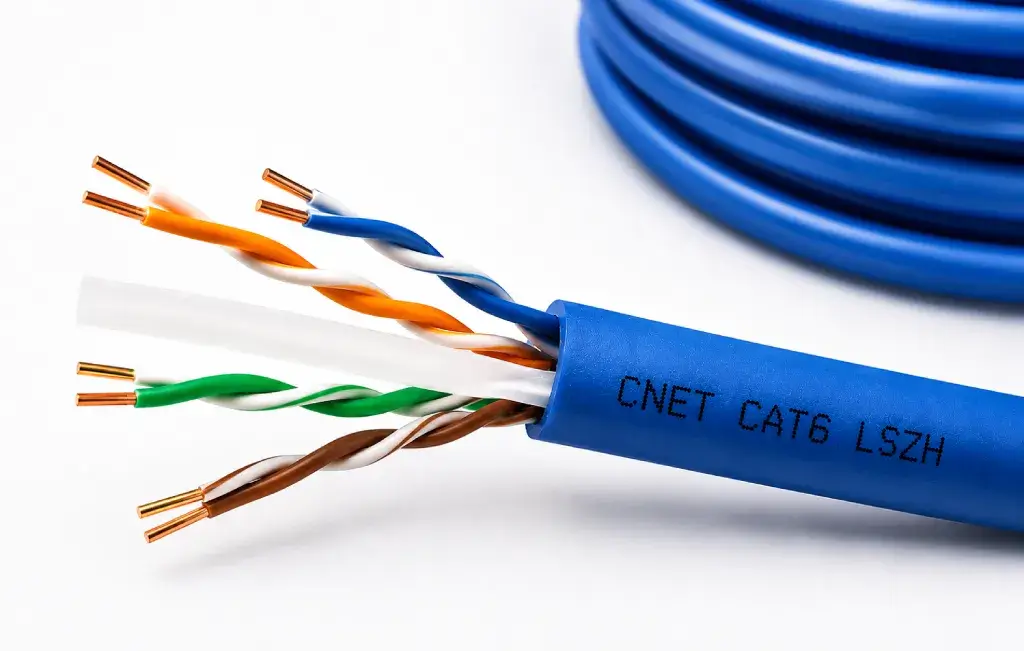
This guide covers everything a specifier, consultant, or installer in Ireland needs to know about Cat6 cable, from ISO/IEC 11801 performance parameters to the differences between internal, external, and LSZH grades, and how CNET's manufactured Cat6 range fits into a warranted structured cabling system.
What Is Cat6 Cable?
Cat6 cable is a twisted-pair copper cable defined by the TIA/EIA-568.2-D standard in the USA and ISO/IEC 11801 internationally and across Europe. It consists of four pairs of 23 AWG (or 24 AWG) copper conductors, tightly twisted and separated by a cross-shaped spline or filler in many designs to reduce pair-to-pair interference, known as crosstalk.
Key Performance Parameters
| Specification | Cat5e | Cat6 | Cat6A |
|---|---|---|---|
| Frequency bandwidth | 100 MHz | 250 MHz | 500 MHz |
| Max data rate (channel) | 1 Gbit/s | 10 Gbit/s (to 55m) | 10 Gbit/s (to 100m) |
| Conductor gauge | 24 AWG | 23 AWG or 24 AWG | 23 AWG |
| PoE standard support | PoE+ (30W) | PoE+ / PoE++ (90W) | PoE++ (90W) |
| Alien crosstalk (ANEXT) | Not specified | Not specified | Specified, required for 10GBase-T to 100m |
| ISO/IEC 11801 class | Class D (channel) | Class E (channel) | Class EA (channel) |
| Typical diameter (UTP) | ~5.5mm | ~6.5mm | ~7.5 to 8.5mm |
Cat6 Cable Applications in Ireland
Cat6 cable is the default specification for:
- Commercial office structured cabling, horizontal and riser distribution
- Education: primary, secondary, and third-level, voice and data convergence
- Healthcare, clinical and administrative areas; check HIQA/HSE specific requirements
- Government and public-sector buildings, under the OGP/DPER standard framework
- Industrial and warehouse LAN, confirm temperature ratings for the environment
- Residential development: multi-dwelling unit (MDU) infrastructure
Cat6 cable is also the minimum specification accepted under the CNET 25-year system warranty for Class E performance when installed with CNET patch panels, modules, and cabinets by a registered CNET installer.
Cat6 Cable Grades: Internal, External, and LSZH
Internal Grade (LSZH or PVC)
Standard Cat6 cable for indoor use. PVC jacket is the lower-cost option and is acceptable where fire performance requirements allow. LSZH (Low Smoke Zero Halogen) jackets are required in environments where toxic fume emission in a fire is a concern, including public buildings, healthcare facilities, schools, and any area with limited egress routes.
Irish building regulations (Technical Guidance Document B: Fire Safety) and most public-sector specifications now mandate LSZH cable in communal and escape-route areas. CNET's internal Cat6 is available in both PVC and LSZH jacket options.
External Grade (Direct Burial / UV-Stabilised)
External-grade Cat6 cables are designed for outdoor or direct-burial use. Key differences from internal grades:
- UV-stabilised jacket (HDPE or similar) that resists solar degradation
- Moisture-resistant filling compound between pairs on direct-burial variants
- Temperature range typically -20°C to +75°C, versus +10°C to +60°C for standard internal cable
- Armoured options available for direct burial without conduit
CNET manufactures external-grade Cat6 for campus and building-to-building runs. Where fibre is not specified, external Cat6 is suitable for runs up to 90m in outdoor environments when correctly installed in conduit.
LSZH (Low Smoke Zero Halogen)
LSZH is a jacket material specification, not a cable category. A cable can be Cat6 LSZH-internal, Cat6 LSZH-external, or Cat6A LSZH. The LSZH designation applies to the jacket compound only and is independent of the electrical performance category.
CNET Cat6 cables are available with LSZH jackets across the product range. Specify LSZH when the installation environment requires it under building regulations or the project specification.
Cat6 vs Cat6A: When to Upgrade
The decision between Cat6 and Cat6A for a new installation is primarily a question of horizontal channel length and future-proofing requirements.
Specify Cat6A when:
- Horizontal runs exceed 55m (the Cat6 10GBase-T limit) and 10 Gbit/s to the desk is a project requirement
- Open-plan office with long runs to access points: 10GBase-T Wi-Fi 6E access points require Cat6A for guaranteed performance
- Building automation, control systems, IP security cameras (4K), and AV distribution at long runs
- Future-proofing: Cat6A is the conservative specification for commercial projects with a 15+ year expected lifespan
Cat6 (Class E) is sufficient when:
- All horizontal runs are under 55m: Cat6 supports full 10GBase-T to 55m
- Budget constraint is significant and future 10GBase-T is not a current requirement
- Riser and backbone runs: for riser infrastructure, fibre is generally preferred over copper at any category
- Small office or residential MDU where 1 Gbit/s to the desk is the performance target
ISO/IEC 11801 Compliance and the CNET 25-Year Warranty
CNET 25-Year System Warranty
ISO/IEC 11801 defines the performance requirements for generic cabling in customer premises. It is the international standard that specifies what a compliant structured cabling system must achieve. In Ireland, this standard is referenced in public-sector and healthcare project specifications and forms the basis for structured cabling system warranties.
CNET structured cabling systems, cable, connectors, patch panels, and modules, are manufactured to ISO/IEC 11801 Class E (Cat6) and Class EA (Cat6A) performance standards. When installed by a registered CNET certified installer using the full CNET channel (cable, connectivity, and patch), the installation is eligible for a 25-year system warranty covering both component and channel performance.
Warranty structure:
- Channel warranty: electrical performance parameters guaranteed for 25 years
- Component warranty: physical and mechanical integrity of CNET components
- Requirement: full CNET channel, cable, patch panel, module, patch cord, and cabinet from the CNET range, installed by a certified installer
- Installer registration is free for qualified cabling contractors
Cat6 Cable Installation: Key Technical Requirements
Good installation practice matters as much as the cable spec itself. Alongside CNET's own installer guidance, a useful independent reference on wider structured cabling installation standards is BICSI's cable installation standards guide, which covers pathway, bend radius, and termination practice in more depth.
Bend Radius
Minimum installation bend radius for Cat6 cable is 4 times the cable diameter, typically 26mm for 6.5mm OD cable. Tighter bends crush the pair geometry and degrade return loss and NEXT. This applies to the entire run, particularly at the exit from wall boxes, under-floor cable trays, and at cable management spines in the cabinet.
Pulling Tension
Maximum pulling tension for 4-pair Cat6 cable is 110 N (25 lbf). Exceeding this during installation stretches the conductor and disrupts twist rates. Use a draw string and swivel connector; do not attach directly to the jacket with a pulling grip that can cinch the pairs.
Pair Untwist at Termination
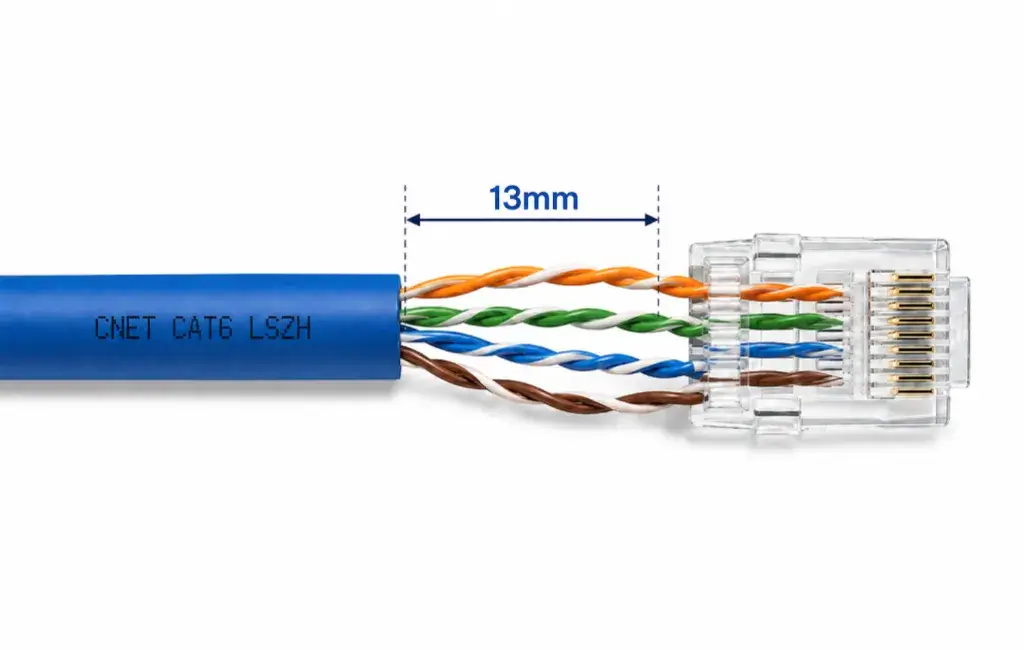
Maximum untwist at the termination point is 13mm (0.5 inches) for Cat6. This is the distance from the point where the pairs split to where each individual conductor terminates on the IDC. Exceeding this significantly degrades NEXT. CNET Cat6 modules are designed with IDC geometry that minimises required untwist to achieve compliant termination.
Bundle Size and PoE Thermal Management
IEEE 802.3bt (PoE++) defines power delivery up to 90W per port. Multiple PoE cables in a bundle generate heat through resistive loss. Large bundles must be de-rated or broken into smaller groups to prevent thermal degradation of the cable jacket and insulation. CNET's technical team can provide bundle de-rating calculations on request for high-PoE-density deployments.
CNET Cat6 Cable Range for Ireland
| Product | Standard | Jacket | Application |
|---|---|---|---|
| Cat6 UTP Internal | ISO/IEC 11801 Class E | LSZH or PVC | Office, education, healthcare, residential MDU |
| Cat6 F/UTP Internal | ISO/IEC 11801 Class E | LSZH | High EMI environments, screened system requirement |
| Cat6 External (UV) | ISO/IEC 11801 Class E | HDPE UV-stabilised | Campus / external runs in conduit, building links |
| Cat6 Direct Burial | ISO/IEC 11801 Class E | HDPE filled | Underground runs without conduit, carpark |
| Cat6A UTP Internal | ISO/IEC 11801 Class EA | LSZH or PVC | 10GBase-T to 100m, Wi-Fi 6/6E AP connections |
All CNET Cat6 and Cat6A cables are available through Wood Communications (woodcomm.ie), from many electrical wholesalers throughout Ireland, and CNET certified installer partners. Contact CNET for full technical datasheets and pull quantities for large project orders.
Source Cat6 Cable Through a CNET Certified Installer
CNET Cat6 and Cat6A cable is available through Wood Communications, from many electrical wholesalers throughout Ireland, and registered CNET installer partners across Ireland. For project specifications, technical data, or installer registration, get in touch with our team.
Frequently Asked Questions
-
What is Cat6 cable used for?
Cat6 cable is used for structured cabling networks in commercial and residential buildings. It carries Ethernet data (1 Gbit/s standard, 10 Gbit/s on short runs), Voice over IP (VoIP) telephony, Power over Ethernet (PoE) for IP cameras, Wi-Fi access points, VoIP handsets, and building automation devices. It is the most widely specified copper cabling standard in new Irish building projects. -
What is the maximum length of a Cat6 cable run?
The maximum permanent link length for a structured cabling horizontal channel is 90m. The maximum channel length, including patch cords at both ends, is 100m. At 10 Gbit/s (10GBase-T), Cat6 is derated to a 55m channel length; for 10 Gbit/s to 100m, Cat6A is required. -
Is Cat6 backward compatible with Cat5e?
Yes. Cat6 cable and connectors are physically and electrically backward compatible with Cat5e and Cat5 systems. A Cat6 patch cable connects to a Cat5e patch panel; a Cat5e patch cable connects to a Cat6 patch panel. The channel performance is limited to the lowest-category component in the link.